Decision Board
Prove local control before choosing sale.
The project does not need more abstract debate. It needs source documents, an exact map, named owners, and a written utility posture.
Test facilities + 200 feet or facilities-only before a broad area CCN.
Water Engineers proposed CCN map is in hand; the signed Waco agreement (Bro. Dadi lead) and source GIS files are still missing.
30-day completeness is real; no statutory CCN decision deadline exists; the 50-acre release lever gives Waco silence a 60-day exit.
Zane must test the Waco and three-lot road-frontage route; plats on groundwater now need the SB 2440 certification.
Keep these lanes separate
Water authority, Phase A1 sale timing, county/title acceptance, engineering capacity, and fallback sale are different clocks. Move them in parallel, then compare written answers.
First proof standard
Signed or source-backed Waco/Ross/Chalk posture, exact F200/facilities map, draft application, operator/engineer scope, and water-operation books.
Signed Waco agreement and Zeke packet exist and are in the source locker.
Waco/Ross/Chalk roles are tied to the actual corridor.
Local-control filing, sale, or fallback clock is chosen from proof. Waco silence past this gate triggers the release-petition decision.
- Bro. Dadi Produce the signed Waco agreementThe single highest-value document. Counsel classifies it: consent, no-protest, service-area agreement, release, or weaker.
- Zeke Send the old packetMaps, letters, draft CCN application, engineer notes, and utility emails.
- Zane / Alex Test Phase A1Waco service path, road-frontage route, plat/title proof, and timing blockers.
- Engineer Name the upgradeCapacity, treatment, pressure, storage, TCEQ, or filing evidence.
- Counsel Check sale conflictWhether a Heritage CCN filing makes a later Chalk Bluff sale harder.
- Admin Pull booksMeters, rates, O&M, cash, debts, reserves, and current water-operation numbers.
Walk out of the Zeke meeting with paper, names, and dates.
Zeke is the source trail for the prior CCN effort: the maps, the agreements, the possibly-started application, and the engineer chain. Every claim from his June 6 call should leave this meeting as a document in hand, a named holder, or a dated commitment — not another oral summary.
Pin down party by party
- When the old effort stalled, which exact route was being pursued: facility corridor, area CCN, dual certification, or sale?
- Why did Waco need to sign — CCN 10039 territory, sewer 20010, plat approval, or relationship?
- Why did Ross need to sign — did the mapped corridor actually cross Ross 11268, or was it a courtesy no-protest?
- Why did Chalk Bluff matter — overlap, the emergency meter/interconnect, sale talks, or politics?
Verify the numbers
- 45 meters plus about 5 more: who calculated it, and what is the limiting factor — well gpm, storage, treatment, pressure, or TCEQ design capacity?
- $20K–$25K "up to par for the CCN" vs the separate $30K–$40K filter number: same job or two jobs?
- 18–24 months: which filing path and what experience is that based on?
- Operator at about $800/month: who is it, what license class, and what does the work actually involve?
Unblock the engineers
- Zeke said engineers stalled waiting on entity, ownership, contacts, address, financials, and financial responsibility.
- What entity name was on the old work — Halbert Water Supply Corporation, Heritage Water Supply LLC, or something else?
- What exactly do the engineers need from us to restart, and who is the engineering contact today?
Zeke's own role
- He said he prefers owning/managing the system if the community can wait — is he willing to be the named operator or manager?
- Would he pursue the license path (short class/test, learn under the existing operator)?
- Can he be the named owner of the document chase with a date?
Where this actually stands.
The goal is an issued Heritage CCN within 12 months, ideally 6. The honest read: 12 months is a real, defensible base case for this specific filing; 6 months is a stretch that requires every gate to go green on the first pass. The two facts that make this case abnormal — Heritage controls the requested land, and the surrounding utilities are friendly — remove the classic delay sources, but only once the friendliness is converted into signed paper.
In hand, verified
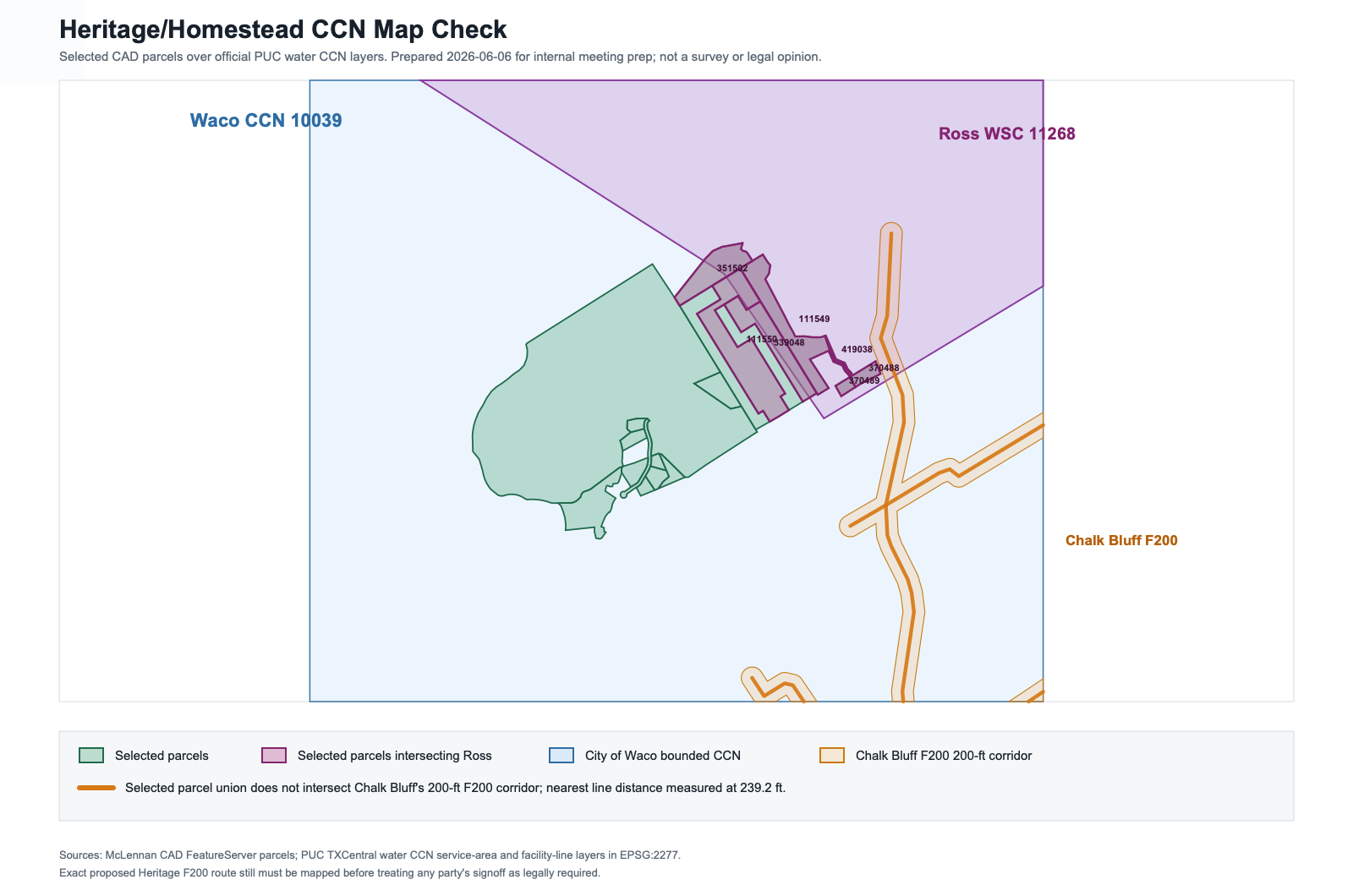
- Live map facts: Waco 10039 definite; Ross 47.5-acre parcel overlap; Chalk Bluff F200 line 239 ft away; no issued HH CCN (re-checked 2026-06-10).
- Operating PWS TX1550143, roughly 45-46 connections, groundwater.
- Current PUC CCN form (Dec 2025) and a packet checklist that matches it.
- Verified clocks: 30-day completeness, 30-day notice window, no 180-day CCN deadline.
- Verified lever: 50-acre expedited release, TWC 13.254(a-1), 60-day clock, McLennan qualifies.
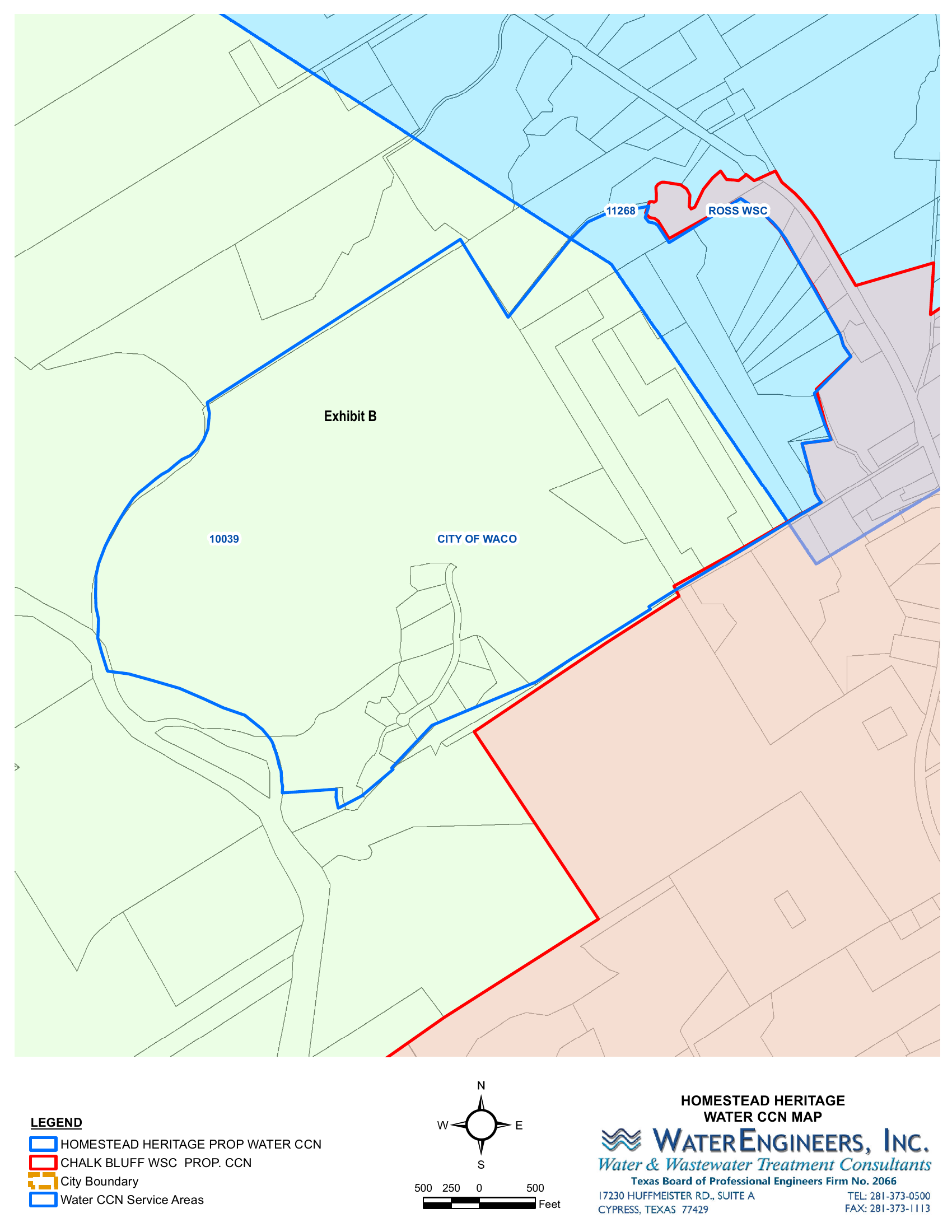
- Recovered Water Engineers proposed CCN map (Exhibit B).
- Simulation blocker map from the June 9 MiroFish run.
Recovered, not yet proof
- The proposed CCN boundary exhibit proves prior work product, not authority.
- "All-but-signed" Waco/Ross/Chalk posture is still oral.
- Zeke's draft CCN application: existence reported, files not produced.
- Operator path (Zeke/Streamline) and engineer path (Ray Young) are named, not signed.
Missing and gating
- Signed Waco agreement (Bro. Dadi lead) — the #1 pull.
- Ross letter and Chalk Bluff no-protest on the exact corridor.
- Exact F200 corridor GIS/shapefile.
- Engineer scope: is $20K-$25K the same job as $30K-$40K?
- Meter list and water books feeding the five-year FMT pro forma.
- Entity decision, officers, and who signs.
- STGCD status + SB 2440 groundwater certification for the plat lane.
- Wastewater statement for phase one.
Planning odds, stated honestly
These are planning estimates from the verified clocks, current docket behavior, and the June 9 simulation — not promises. They move week by week with the document pulls.
Why this one can beat the average
- Heritage controls the requested land, so the 25+ acre landowner notice/opt-out class is essentially internal. The classic outside-landowner delay is gone.
- Waco, Ross, and Chalk Bluff are reportedly friendly. Friendly utilities cannot opt out, but they can protest — converting posture to signatures is what closes that door.
- The system already operates as a real PWS, so FMT is a books problem, not a hypothetical-utility problem.
- The ask is a narrow F200 corridor, not a 500-acre monopoly.
- Prior map/application work exists and is being recovered.
- If Waco stalls, the 50-acre release petition puts the territory question on a 60-day statutory clock over land where Waco has no pipes and near-zero compensable value.
What we are taking for granted.
The strategy is settled. These are the load-bearing assumptions written as "verify later" and then quietly treated as fact. Each one, if wrong, moves the timeline or breaks the path. Ranked by how badly it bites and how cheaply it can be checked.
1 · "Halbert WSC" is a vehicle we control
The checklist says it is inactive on SOS; the transcript first called it "Hubbard"; a June 13 web search found zero public footprint anywhere. A WSC is member-owned by law — reviving a forfeited shell can resurrect old members, board, and debts, and Heritage may not control it.
Bite: a whole officer/bylaws packet built around a shell that cannot be used at filing. Check: SOSDirect / Comptroller entity lookup before any field is filled.
2 · A WSC gives Heritage control
Chapter 67 WSCs are member-controlled, one-member-one-vote, with strict 501(c)(12) private-benefit limits. The design intent is that the developer does not control it. Treating "Heritage WSC" as the control path may be backwards.
Bite: 12 months to a CCN held by an entity leadership cannot steer, or that trips private-benefit rules. Check: one counsel question — WSC vs. investor-owned/LLC CCN for control.
3 · December 2026 is a fixed deadline we must beat
The exact trigger, dollar amount, and amendability of the homestead purchase agreement (G1.4) have never been read into the record. The whole urgency — and the September release decision rule — is calibrated against an unverified constraint.
Bite: sprinting against a deadline that is softer (amendable) or harder (worse exposure) than assumed. Check: read the actual contract clause — arguably ahead of the WSC packet.
4 · Waco is friendly-but-slow, not adverse
The only Waco document is an unsigned 2021 draft that may be expired, with Ray's comments flagging real problems. The release fallback (TWC 13.254(a-1)) has an unresolved linchpin: does Heritage's existing PWS service defeat the "not receiving service" element?
Bite: a protest turns the 60-day release clock into a multi-year contested case, and the BATNA may not qualify. Check: get the 13.254 element answered before September, not at the decision point.
5 · Solving water unlocks platting
The tract sits inside Waco's sewer CCN too; McLennan rules require a wastewater plan to plat; SB 2440 makes groundwater-availability certification mandatory; and the Trinity well faces a data-center drawdown risk with STGCD status unverified.
Bite: water CCN filed, then subdivision stalls on wastewater capacity or a groundwater cert that cannot be supported. Check: confirm with the county what phase-one platting actually requires.
6 · The system stays stable while we negotiate
Two single points of failure keep 46 live connections compliant: one contracted operator (name unverified) and an emergency-only Chalk Bluff interconnect that "may be at risk of shutoff" — and we are about to ask Chalk Bluff for a favor while drinking their water.
Bite: a lapsed operator makes us non-compliant exactly when proving capability; soured talks cut the emergency supply. Check: confirm the operator contract is durable; read the interconnect terms first.
7 · "Filing-ready" means "subdivision-ready"
A CCN filing is not a grant; the 30-day completeness clock is not a decision clock; lenders and title need actual service authority, not a pending application. The "filing-readiness sprint" language quietly invites the confusion.
Bite: the December math breaks if "we filed" gets treated as "we can convey lots." Check: hold the distinction explicitly in every status update.
The meta-risk · transcript creep
Load-bearing numbers — $600K build, $225K–$250K Chalk offer, $800/mo operator, 46 connections, 90-day transfer, the "Halbert" name — entered via transcripts and memory, were tagged "verify," and have propagated until they feel like fact.
Bite: decisions anchored on figures nobody confirmed. Check: honor the tracker's "Do Not Use Yet As Proof" list under deadline pressure.
One runway from paperwork to usable authority.
The first 30 days are not the whole project. They are the proof sprint that decides whether the 10-12 month clean filing path is realistic, or whether the team should pivot to a written fallback.
Gate 1: June paperwork
Do we have the signed Waco agreement, map, draft application, engineer lead, water books, and Phase A1 files? If not, the next weeks are still document recovery.
Gate 2: September posture
Do Waco and Ross give a workable written path on the exact map, and does counsel say sale optionality remains manageable? Waco silence at this gate triggers the 13.254(a-1) release-petition decision.
Gate 3: Sep-Oct filing
Is the PUC packet complete enough to file without a predictable deficiency round: maps, FMT, tariff, operator, engineer, TCEQ, and notices?
Get these before the next strategy round.
The next meeting should not be another abstract discussion. It should be a document review. One item is already recovered: the Water Engineers proposed CCN map (June 10). The rest are still open.
| Need | Source | Why it matters |
|---|---|---|
| Signed Waco document | Bro. Dadi Lev-Cochav / Zeke / Carl files | The #1 pull. Proves whether Waco has already consented, no-protested, or only discussed the route. Counsel classifies it on receipt. |
| Ross letter/agreement | Zeke / Ross file | Shows whether Ross is already aligned and whether the document is still current. |
| Chalk Bluff letter | Zeke / Chalk Bluff / Carl files | Useful as no-protest, fallback, or proof of prior posture; exact addressee and wording matter. |
| Draft CCN application | Zeke / engineer | If it exists, use it as the working packet and audit missing attachments. |
| Facility maps / 200-foot map map recovered 6/10 | Zeke / Alex / engineer | Decides whether Waco, Ross, and Chalk Bluff are consent, notice, protest, or strategy parties. The Exhibit B PDF is in hand; source shapefiles/CAD and the engineer transmittal are still needed. |
| Engineer capacity and upgrade scope | Ray Young / engineer / Zeke | Separates filtration, capacity, pressure/storage, TCEQ, and PUC-proof work. |
| Meter list and water books | Simeon / admin / operator | Feeds the five-year pro forma and proves the system is already operating. |
| Phase A1 / survey / plat files | Alex / Zane / Isaac | Lets Zane answer whether Waco or a three-lot road-frontage route can move lots first. |
Every live blocker needs a named person.
| Person / group | Current role | Ask |
|---|---|---|
| Bro. Dadi Lev-Cochav | Reported holder of the signed Waco agreement tied to the recovered proposed CCN map. | Produce the signed Waco agreement and any companion Ross/Chalk Bluff documents or engineer transmittals. |
| Zeke | Document source, current system knowledge, possible operator candidate. | Produce maps, agreements, draft CCN application, engineer contacts, and upgrade explanation. |
| Hudson Gately | Water Solutions group; channel that surfaced the recovered map. | Chase the source package behind Exhibit B: shapefiles/CAD, map date, transmittal, application draft. |
| Zane | Waco/subdivision contact. | Test Phase A1, Waco written answer, and two/three-lot road-frontage route. |
| Ray Young / engineer | Engineering capacity and upgrade proof. | Name the limiting factor, upgrade scope, cost, trigger, and whether it blocks filing or only future taps. |
| Patricia Ferguson | Water/municipal attorney mentioned by Isaac. | Review facilities + 200 / facilities-only timing, consent documents, and sale-option conflict. |
| Alex | Survey, plat, and map source. | Provide phase surveys, road-frontage facts, and any map needed for the filing route. |
| Isaac French | Interested private party/property owner with timing concern. | Clarify deadline/carrying cost and what proof would change the sale-speed argument. |
| Streamline / Zeke / other operator | Possible licensed-operator path. | Identify who can sign an operator letter, license class, license number, cost, and backup plan. |
| Water Solutions stream | Research and packet build crew. | Convert transcript claims into map, law, agreement, engineering, finance, and open-question artifacts. |
Track separate clocks instead of one big water problem.
Signed Waco agreement (Bro. Dadi), Zeke packet, Ross papers, Chalk Bluff letter, draft CCN application. Proposed CCN map recovered June 10.
Exact F200 or facilities-only corridor, Waco/Ross/Chalk overlay, Phase A1 footprint.
Filing route, no-protest/consent form, sale conflict, release-lever sequencing. Clocks verified 6/10: 30-day completeness real, no 180-day CCN deadline.
Capacity limit, filtration/treatment, storage/pressure, upgrade cost and trigger.
Meter list, rates, operator cost, water books, five-year pro forma, backer proof.
Zane/Alex: Phase A1, road frontage, three-lot route, county/title/lender proof.
Only wins if retail-water timing, approvals, rates, assets, and easements are written.
Track sewer, roads, data-center leverage, retail provider, taxes, concessions, and water-system value.
Open the source before repeating the claim.
This dashboard should point back to the actual artifacts. If a claim is not tied to one of these or a named missing document, keep it in the open-question column.
| Artifact | Use it for | Link |
|---|---|---|
| June 6 Heritage/Homestead transcript | What was actually said in the latest meeting. | Transcript |
| June 6 meeting readout | Current direction, people, missing docs, Tuesday action list. | Meeting readout |
| Map image | Waco/Ross/Chalk Bluff overlay and current visual proof. | CCN map PNG |
| Recovered proposed CCN map | Water Engineers Exhibit B showing proposed Homestead Heritage water CCN, proposed Chalk Bluff WSC CCN, Waco 10039, and Ross 11268. | PDF / PNG |
| Timing sheet | Sale path vs F200 timing and government clocks. | Timing text |
| Filing checklist | Every form, attachment, map, agreement, and proof item needed for a filing packet. | Filing checklist |
| WSC vs co-op / Lacy filter | Entity-choice comparison and annexation lane filter. | WSC / Lacy text |
| Zeke call transcript | Lead sheet for missing maps, agreements, upgrades, and operator assumptions. | Zeke transcript |
| Chalk Bluff May 2026 minutes | Latest CBWSC public minutes in repo; Waco CCN update and hydraulic mapping vote. | May minutes |
| June 10 clock and release verification | Verified clocks (30-day completeness, no 180-day CCN deadline), 50-acre release lever, SB 2440 plat certification, live layer re-checks, current-form confirmation. | Verification note |
| June 9 MiroFish simulation report | Ranked blockers, first-30-day proof package, and timeline gates from the stakeholder simulation. | Simulation report |
Newest records that change the dashboard.
June 10 verification pass
- 30-day administrative-completeness clock confirmed; deficiency cures run about 30 days per round.
- No 180-day statutory CCN decision deadline exists; that figure belongs to the STM sale path (16 TAC 24.239(o)).
- 50-acre expedited release (TWC 13.254(a-1)) confirmed available in McLennan: 60-day statutory clock, compensation by appraisal, and Waco has no facilities at the tract.
- SB 2440 groundwater-availability certification (TCEQ-20982) is mandatory for groundwater-supplied plats since January 2024.
- Live PUC layers re-checked: Waco 10039 unchanged; still no Heritage/Homestead/Halbert record.
- December 2025 CCN form confirmed current; the filing checklist matches it.
June 10 proposed CCN map
- Water Engineers Exhibit B is now in the dashboard pack as PDF and PNG.
- The map shows a proposed Homestead Heritage water CCN boundary and proposed Chalk Bluff WSC CCN boundary.
- It confirms useful prior work product, not an issued HH CCN.
- Message lead: Bro. Dadi Lev-Cochav may have the signed Waco agreement.
June 6 internal meeting
- Lead path shifted toward Heritage-controlled WSC / facilities + 200 feet or facilities-only.
- Sale stays as fallback, but counsel must answer whether filing a Heritage CCN hurts sale optionality.
- Zeke is the document source: maps, agreements, draft application, engineer notes.
- The room specifically wants the actual CCN application if it was already started.
- Zane/Alex own the Phase A1 / road-frontage subdivision test.
- If local-control prep and sale prep can both continue without conflict, keep both lanes alive until the proof decides.
- Tuesday is the next paperwork checkpoint.
Chalk Bluff latest minutes
- May 12 minutes say Kathleen Dow reported everything looked good with Waco CCN and the next Waco update should be in July.
- May 12 minutes show CBWSC approved hydraulic mapping for $66,200.
- April minutes said that mapping/pressure-plane/hydraulic work should take about 20 weeks.
- April minutes also show CBWSC voted to move forward with a dual CCN map with Ross/RWSC.
- These support the "get actual maps and letters" lane; the signed Waco/Ross/Chalk package still has to be produced.
Treat Isaac as a timing lane, not the project driver.
Isaac's property is a timing lane, not the whole project. His pressure point can still expose whether Waco or a small platting path can move Phase A1 while the Heritage-controlled water path is being proved.
Project stance
- Keep Phase A1 moving in parallel with the WSC/F200 path.
- Ask Waco for three choices: serve Phase A1, consent/no-protest to our narrow route, or refuse in writing.
- Ask Zane whether a two/three-lot road-frontage filing can move faster than the full subdivision route.
- Ask Alex for the phase survey and road-frontage map needed to test that route.
- Any plat relying on groundwater now needs the SB 2440 groundwater-availability certification (TCEQ-20982 by a PE/PG) or a county waiver — fold STGCD status into the Zane/Alex packet.
- Use Isaac's deadline facts as schedule pressure, not as the reason to sell the whole water system.
Questions for Isaac / Zane / Alex
- What exact deadline or carrying cost is driving the sale clock?
- What proof would justify a 30-day pause before sale talks move forward?
- Has anyone asked Waco the narrow Phase A1 question in writing?
- What exact Waco document would let the parcel plat, title, and close?
- Can Phase A1 or nearby lots be filed two or three at a time with road frontage?
- Would repeated small filings create future subdivision problems?
The exact map controls who matters.
Current map work does not prove "only Waco" or "all three must sign." The newly recovered Water Engineers exhibit proves a proposed-map workstream existed. The official parcel overlay still says Waco is definite, Ross is a real corridor question, and Chalk Bluff is nearby/history/interconnect risk rather than selected-parcel overlap.
Waco
City of Waco water CCN 10039 is the clear mapped gate. The planned F200 path needs Waco handled by consent, no-protest, dual certification, amendment, release, or another counsel-approved mechanism.
Ross
Ross WSC 11268 overlaps seven selected Halbert/Gholson/Homestead Gristmill parcels. The exact proposed F200 corridor must be checked before saying Ross is optional.
Chalk Bluff
Chalk Bluff WSC 10019 is an F200 facility-line CCN nearby. Current selected-parcel check does not show overlap, but Chalk Bluff still matters if the plan uses its facilities, interconnect, service, sale, or contract rights.
F200 is the CCN path to test.
The work is to build the PUC-recognized authority packet: entity, exact map, need, FMT proof, operator/engineering proof, finances, and the right written posture from any overlapping or affected utility.
| Rule | Plain-English point for the room | Meeting use |
|---|---|---|
| 16 TAC 24.225 | A utility or WSC generally cannot provide retail water/sewer service to the public without first obtaining a CCN. | PWS operations status is not enough for conveyed lots. |
| WSC / co-op model | In Texas water language, the practical "co-op" model is usually a Chapter 67 Water Supply Corporation: nonprofit, member/customer-owned, board-run. It can be the applicant, but it still needs PUC authority. | Use WSC for local control; use F200/CCN for the legal service-area route. Treat any separate "co-op" shortcut as unsupported unless counsel identifies a real water statute. |
| 16 TAC 24.227 | PUC tests financial, managerial, and technical ability; for separate systems, nearby utility service evidence can matter. | Zeke's "ask all three" may be shorthand for map/nearby-utility proof, not a blanket consent rule. |
| 16 TAC 24.233 | Application contents include maps, need, approvals/consents where applicable, capital plan, funding, financials, landowners, and TCEQ/contract proof. | The sprint builds this packet before anyone files. |
| 16 TAC 24.257 | CCN applications need general and detailed maps, survey/plat/shapefile, exact facility mapping where applicable, and mapper attestation. | The next decisive artifact is the exact F200 corridor map. |
| 16 TAC 24.253 | Service-area contracts are PUC-approved and apply to transfers between existing CCN holders. | Any Waco paper needs counsel to tie it to the correct PUC-recognized mechanism. |
| 16 TAC 24.245 | Release/decertification can be a backup when service/refusal facts support it, but it brings proof, compensation, and timing issues. | Lead with consent/no-protest if possible; keep release as fallback. |
| TWC 13.254(a-1) verified 6/10 | A landowner of a 50+ acre tract not in a platted subdivision actually receiving service may petition for expedited release from a CCN; the PUC must rule within 60 days of completeness; compensation is set by appraisal. Applies in McLennan. Release removes Waco's certificate but does not grant Heritage retail authority. | This is the dated BATNA behind the Waco ask. Counsel must clear the "actually receiving service" reading given Heritage's own PWS, and pair release with the Heritage CCN filing. |
| TWC 13.246(h) verified 6/10 | Owners of 25+ acre tracts in a requested area get mailed notice and can opt out within 30 days, effective without further hearing. No 180-day decision deadline exists anywhere in 13.246. | Because Heritage controls the requested land, the opt-out class is internal — a structural speed advantage no outside applicant gets. |
If someone says "co-op," ask what statute they mean.
For a Texas water utility, the clean local-control entity is a Chapter 67 Water Supply Corporation. Calling it a co-op does not change the CCN, TCEQ, operator, engineer, FMT, or Waco/Ross map requirements.
Chapter 67 WSC
- Nonprofit water/sewer corporation under Texas Water Code Chapter 67.
- Board-run, with members/customers and published rates/conditions.
- Fits the water job: own/operate facilities, apply for CCN, collect membership/tap/capital fees, keep local control.
- Still needs PUC-recognized authority before retail-billing conveyed lots.
Generic co-op
- Useful as plain English only if everyone means "member-owned utility."
- Texas Utilities Code Chapter 161 is for electric cooperatives, not a water CCN path.
- No evidence it reduces PUC/TCEQ/FMT burden for water.
- Creates avoidable confusion unless counsel says a different entity is better.
| Question | Answer for the room |
|---|---|
| Is a co-op different from a WSC? | Usually not in the way people mean it here. A WSC is the Texas water version of the member-owned/co-op idea. |
| Does it require less money to run? | No meaningful shortcut. It may avoid profit/shareholder pressure and use a volunteer board, but operator, testing, power, repairs, insurance, accounting, legal/PUC, engineering, mapping, FMT proof, and upgrades still exist. |
| Why choose WSC anyway? | Because it is the clearest local-control applicant for a narrow F200/CCN path while keeping the water asset accountable to the community. |
Lacy is a strategic option, not Tuesday's filing path.
The meeting did not dismiss Lacy. It treated Lacy/data-center annexation as a potentially valuable long-range infrastructure lane because it could bring sewer, roads, regional leverage, or future water-system value. Keep it warm, but require written terms before letting it replace the Heritage WSC/F200 proof sprint.
Why it stays warm
- The meeting raised a Lacy Lakeview mayor/data-center conversation tied to Brazos River access.
- Annexation could potentially bring sewer, road responsibility, and regional infrastructure capacity.
- Keeping the water system may make Heritage more valuable in that conversation, not less.
- It may become useful later if Heritage wants a larger service-area, city/incorporation, or regional utility strategy.
What must be written before it leads
- They identify the exact annexation/corridor route.
- They say who provides retail water and sewer after annexation, and under what authority.
- They identify every Waco/PUC/TCEQ action still needed.
- They put cost, capacity, rates, timing, taxes, road obligations, and required Heritage concessions in writing.
- They say whether the Heritage water system would be bought, contracted, connected, or left alone.
Use Zeke as the source trail, not the final answer.
The call and meeting are valuable because they identify missing documents and likely blockers. The next move is to collect the maps, signed letters, draft application, and engineer notes behind the claims.
Useful leads from the call
- Engineers may be waiting on entity, ownership, contact, address, financials, and financial responsibility.
- Current system is reported around 45 meters, with about 5 more before capacity pressure.
- Zeke reports an engineer-related $20K-$25K upgrade estimate, but the item and trigger are not identified.
- Carl-source notes separately mention a filter-system upgrade around $30K-$40K.
- Zeke said he favors owning/managing the system if timing allows.
- Selling water to Chalk Bluff does not solve the separate sewer issue.
Claims to correct or prove
- "All three must consent" is not proven as a blanket legal rule.
- No PUC rule found creates a hard 45- or 50-meter CCN limit.
- $20K-$25K is not a budget until the engineer writes the scope, reason, and timing.
- Keep the $20K-$25K capacity/CCN estimate separate from the $30K-$40K filter estimate until the engineer confirms they are the same job.
- 18-24 months is an experience estimate, not a rule.
- Signed/draft agreements must be produced before relying on them.
Upgrade questions for Carl / Zeke
- What exact component is this: filter, storage tanks, pressure, pump, treatment, controls, meters, backflow, sampling, or mapping?
- Who gave the number and when?
- What written engineer email, memo, quote, or plan/spec note supports it?
- What problem does it fix: TCEQ compliance, PUC FMT proof, pressure, storage, peak demand, or added meters?
Why it matters
- If required for TCEQ compliance, it may be urgent operations work.
- If required for PUC CCN proof, it may belong in a capital improvement plan.
- If required only for extra meters, it may not block a Phase A1/Waco written-answer sprint.
- If it is just a rough capacity tweak, it should not drive a sale decision.
The upgrade number is the first hard question.
Before treating this as a budget, pin down what the upgrade is, why it is needed, who gave the number, and when it has to happen. Right now the sources conflict.
| Source | What we know | What has to be answered |
|---|---|---|
| Zeke / engineer oral lead | Roughly $20K-$25K in upgrades, described as getting the system up to par for the CCN and getting more capacity. | Is this filtration/treatment, storage, pressure, pump, controls, sampling, meters, mapping/as-builts, or something else? Is it written anywhere? |
| Water Solutions follow-up | One participant said the last meeting comment they heard was that filtration upgrades were needed for the CCN. | What contaminant, test result, TCEQ requirement, operator note, or engineer note makes filtration necessary? |
| Carl-source meeting notes | Separate notes list a filter-system upgrade around $30K-$40K. | Is this the same filtration issue, an older estimate, a bigger treatment scope, or a different project? |
| Capacity lead | Zeke reports about 45 meters now, about 5 more before capacity pressure, and an 85% capacity concern. | What is the actual limiting factor: well gpm, Trinity permit, storage volume, treatment rate, pressure, distribution pipe, or meter policy? |
| Timing question | The rule review does not prove upgrades must be finished before filing. | Are they required before filing, inside the PUC capital plan, before final approval, before added meters, or immediately for operations? |
Use this in the room
- "The number is not the answer. The scope is the answer."
- "If this is TCEQ compliance, say so. If it is PUC FMT proof, say so. If it is capacity for new meters, say so."
- "We can test the Heritage-controlled path only if the engineer gives the item, reason, cost, and trigger."
- "Selling now because of an undefined upgrade is a bad decision."
Documents to pull
- Engineer email or memo behind the $20K-$25K number.
- Operator notes, TCEQ reports, sampling results, and any filtration/treatment deficiency.
- Storage, pump, pressure, well, permit, and daily/peak-demand numbers.
- As-builts, meter list, facility map, and old CCN map package.
| Role to cover | Why it matters | Question to answer in the room |
|---|---|---|
| Texas PE / engineer | Capacity letter, upgrade scope, capital plan, facility proof, and plan/spec path if needed. | Who is the engineer, what have we already paid for, and who can get the latest email today? |
| Licensed operator / TCEQ operations | Weekly testing/reporting, compliance proof, treatment settings, and what sits under the operator's license. | Who is responsible today, who is the backup, and is anyone in-house willing to start the Class D path? |
| Finance / admin / books | PUC FMT proof, current financial statement, five-year pro forma, tariff/fees, backer proof, entity records. | Who owns the books, who signs, and who can produce financial proof without turning this into a sale? |
| GIS / map / as-builts | Exact F200 corridor, well/tank/main/meter locations, Waco/Ross/Chalk Bluff overlap, PUC mapping exhibits. | Who has the old maps and field knowledge, and what must be sealed by survey or engineer? |
| PUC / water counsel review | Route choice, consent/no-protest structure, application risk, and whether upgrades belong in the filing or before service. | Who reviews the packet before anyone contacts Waco, Ross, Chalk Bluff, PUC, or TCEQ? |
| Entity / officers | WSC or other approved entity, board/officers, contact/address, asset ownership, responsibility for operations and finances. | Are we using Halbert WSC, new Heritage WSC, or another entity, and who is willing to be accountable? |
PUC needs a specific financial packet.
If the applicant is new, PUC will not expect old CCN history from an entity that did not exist. It will expect current/startup financials for the applicant, existing water-operation books if available, and a five-year projection showing continuous and adequate service.
| PUC item | Actual number | What Heritage must produce / verify |
|---|---|---|
| Projection period | 5 years | Year 1-5 meters/taps, rates, fees, O&M, repairs, capex, debt, and cash flow. |
| Applicant financial statement | Current balance sheet/financial statement for the applicant; if an existing entity files, audited financials can substitute if issued within 18 months. | Applicant cash/reserves, debts/obligations, startup assets, who signs, and who backs shortages. |
| Existing water-operation books | Not old CCN history. Use the current PWS/water-operation records if the new applicant has no operating history. | Meter list, water revenue, operator cost, testing, chemicals, power, repairs, insurance, admin, debt/leases, and unpaid bills. |
| Leverage test | Debt/equity less than 1.0, or DSCR greater than 1.25, or unrestricted cash equal to 2 years debt service. | If we borrow, show the debt test. If we self-fund, show cash/reserve/backer instead. |
| Operations test | Enough cash to cover projected O&M shortages in the first 5 years. | Calculate the Year 1-5 shortfall and name who covers any gap left by rates/fees. |
| Plant work over $100K | If the engineer says required plant/equipment will cost more than $100,000, PUC wants proof the money is real: loan approval or signed capital commitment. | Engineer must say what work is required, what it costs, and whether it crosses $100K. |
| Tariff / rates | Applicant needs proposed tariff/rates; projections need rate and fee assumptions. | Monthly charge, gallonage, tap fee, capital/connection fee, reconnect/transfer fees. |
Use our live numbers
- Start with reported 45 meters, then verify from the meter list.
- Put only the new taps Heritage would actually serve into Year 1-5; keep Waco/Phase A1 separate unless counsel says those lots belong in the Heritage filing.
- Separate operator cost, testing, electricity, chemicals, repairs, insurance, admin, and professional fees.
Backer math
- Minimum backstop equals the 5-year projected O&M shortfall.
- If required plant work exceeds $100K, add a signed funding commitment or loan approval for that work.
- Backer can cover temporary cash shortages only if the backer passes a leverage test.
Ask today
- Can the existing water-operation books be separated from church/property books?
- What is the real current rate and tap/connection fee?
- Are the $20K-$25K and $30K-$40K items under the $100K trigger alone or part of a bigger required CIP?
Compare time to lawful retail water.
The timing question is not about Phase A1. Phase A1 is a Waco question. This comparison is how long until lawful retail water if Heritage sells to Chalk Bluff versus how long until lawful retail water if Heritage files the F200 path.
1. Find the proof
Build the exact F200 map, pull the meter list/books, pin down the upgrade scope, and list what Waco/Ross need to answer.
Slows down if: maps are missing, upgrade scope is vague, or nobody has the water-system records.
2. Build the application packet
Prepare the WSC/applicant info, rates, five-year numbers, backer/reserve proof, operator letter, engineer letter, and landowner list.
Slows down if: finance proof, operator, engineer, filtration answer, or parcel data is weak.
3. Get Waco/Ross answer
Ask for a written yes, no-protest, or refusal on the exact corridor. This is the main timing gate.
Slows down if: Waco or Ross fight it, will not answer, or want a different route.
4. File a complete packet
Submit the PUC CCN application with maps, finances, engineer/operator proof, tariff, TCEQ items, and numbered attachments.
Slows down if: PUC says the filing is missing items. Each deficiency round can cost about 30 days.
5. Get through notice and questions
Send required notices, answer PUC Staff questions, handle landowner opt-outs, and fix map or tariff comments.
Slows down if: notice is wrong, people object, a utility protests, or Staff asks for major changes.
6. Finish the order
Resolve final Staff comments, finalize the map/tariff, clear TCEQ or engineering questions, and target an uncontested order.
Slows down if: there is a hearing, unresolved protest, or required treatment/construction work is not settled.
Dates we cannot skip verified 6/10
- Administrative completeness is determined within 30 calendar days of file stamp — this is the real "30-day clock."
- There is no 180-day statutory deadline for a CCN decision; TWC 13.246 contains none. The "180 days" people remember is the STM sale-path approval-to-proceed window (16 TAC 24.239(o)).
- If PUC says the packet is incomplete, the fix window is usually about 30 days per round.
- After notice goes out, people have 30 days to object or intervene; 25+ acre landowner opt-outs are effective without further hearing — and here that class is internal to Heritage.
- Newspaper notice runs two weeks, and proof of notice has its own deadlines.
- After a final CCN order, the map change must be recorded in county records by day 31.
- Sale/STM clocks for comparison: 120-day runway, at least 30-day intervention, and the 180-day closing window.
- Release lever: a 13.254(a-1) expedited-release petition must be decided within 60 days of completeness.
What is mostly on us
- There is no required waiting period before filing. We can move as fast as the packet is complete.
- There is no guaranteed PUC order date after filing.
- PUC speed depends on clean maps, clean finances, clean notice, and no protest.
- TCEQ only becomes a major timing problem if real construction, treatment, or system changes must be approved first.
The filing is not one form. It is this packet.
A Heritage filing is only as strong as its forms, attachments, maps, agreements, and proof items. Use this as the build list for the proof sprint. Checked against the current PUC form on June 10, 2026: the December 2025 revision (re-posted January 2026) is still current and this list matches it.
| Official form / page | Plain-English use | Link |
|---|---|---|
| PUC CCN Obtain / Amend application | Main filing for a new/amended Heritage WSC water CCN. | CCN_Form_PFA.pdf |
| PUC Water Utility Tariff Form | Customer rates, fees, and service rules. | Water_Utility_Tariff.pdf |
| PUC CCN Mapping Resources | Map rules, official CCN data, shapefile guidance, and mapper attestation source. | PUC mapping page |
| PUC Interchange Filer | Electronic filing portal after the packet is ready. | Interchange filer |
| TCEQ plan review page | Needed if construction, treatment, storage, wells, interconnect, or major changes are part of the filing. | TCEQ plan review |
| TCEQ-10233 Plan Review Submittal | TCEQ cover form for plans/specs. | TCEQ-10233 |
| TCEQ-10400 Core Data | TCEQ identity/regulated-entity record if entity/system record must be created or changed. | Core Data page |
| TCEQ-20841 Financial Ability | TCEQ financial proof if the project is treated as a new system/plan-review trigger. | TCEQ-20841 |
| TCEQ conditional checklists | Use only for triggered work: distribution, interconnect, storage tank, pressure tank, well, well completion, chemical feed, or disinfection. | TCEQ forms/checklists |
| Packet file / agreement | Required? | Simple meaning |
|---|---|---|
| Signed/notarized PUC oath | Required | Responsible person swears the filing is true. |
| TCEQ Regulatory Assessment Fees current + Emergency Preparedness Plan filed or waived (TWC 13.1396) | Required (form Part A) | The form asks both up front; clear them before filing, not after a deficiency letter. |
| Entity papers: articles, bylaws, account status, name-change certificate if any | Required/conditional | Proves who Heritage WSC is and who can file. |
| Applicant contacts and owner/operator/engineer/attorney/accountant names | Required | Names the responsible people. |
| Requested-area land-use statement | Required | Explains the phase, lots, facilities, and service request. |
| Waco dual-certification / consent / no-protest agreement or public-interest statement | Required if Waco overlap is in the route | Waco's written posture for the exact F200 corridor. |
| Ross consent/no-protest or dual-certification agreement | Conditional | Needed if exact corridor overlaps Ross. |
| Agreement for decertification/amendment | Conditional | Needed if we ask to remove territory from Waco/Ross and add it to Heritage. |
| Municipal franchise/permit/consent | Conditional | Only if the requested area is inside municipal corporate limits; ETJ alone is a separate issue. |
| Written requests for service and utility responses | Conditional | Shows whether nearby utilities can/will serve, or failed to respond in 30 days. |
| Cost analysis of neighboring utility service | Conditional | Compares Heritage service with neighboring service. |
| Customer growth / market study | Conditional | Proves expected connections and need for service. |
| TCEQ engineering approval letters or submittal proof | Conditional but likely important | Shows TCEQ approved or received plans/specs for required work. |
| Capital improvement plan keyed to map | Required if work is needed | Budget, timeline, and map of required facilities/improvements. |
| Loan approval or firm capital commitment | Required if required plant/CIP exceeds $100K | Proof the money exists. |
| Enforcement correspondence | Conditional | Any PUC/TCEQ/EPA/other compliance action. |
| PWS list and TCEQ CCI reports | Required | For us, likely PWS TX1550143 plus inspection/compliance proof. |
| WQ discharge permits and CCI reports | Conditional sewer item | Needed if sewer/wastewater is in the filing. |
| Existing customer/meter list and projected customer list | Required | Current connections plus any new connections proposed for Heritage service. |
| Purchased water/treatment agreement | Conditional | Needed if buying capacity from Waco, Chalk, Ross, or another provider. |
| Capacity and moratorium statement | Required | Can the system serve current/projected demand and are new taps blocked? |
| Licensed operator list | Required | Name, class, license number, water/sewer responsibility. |
| Proposed applicant tariff/rate schedule | Required | Rates, tap fees, reconnect/transfer fees, service policies. |
| Applicant current/startup financials plus existing water-operation books if available | Required | Applicant balance sheet/cash/backer proof, plus current PWS/water-operation revenue and expenses if the applicant has no operating history. |
| Five-year projected financials / Appendix B | Required if new connections/new investment or Staff asks | Year 1-5 rates, O&M, capex, debt, cash, and backer math. |
| Affiliate disclosure | Required | Related-party ownership/control/financial relationships. |
| General map, detailed map, legal boundary/shapefile, infrastructure map, mapping attestation | Required | The exact F200 corridor and facilities, not a rough parcel screenshot. |
| Notice description and map/tariff viewing address/contact | Required | Landmark description, acres, CCNs affected, PWS IDs, and where public can view maps/tariff after PUC orders notice. |
The simulation agrees: paper beats pipes.
A multi-agent stakeholder simulation was run against the project's verified seed facts to stress-test the timeline. Its core finding matches the timeline reality check from the opposite direction: the controlling risk is not engineering — it is whether Waco, Ross, Chalk Bluff, the county, title, and lenders can all see the same written authority chain. Treat the percentages as rehearsal estimates, not public-record probabilities.
| # | Blocker | Simulated likelihood / severity | Delay effect |
|---|---|---|---|
| 1 | Waco silent delay — no clean yes/no while requesting more information | Highest | 4-6 months alone; more if it spawns second-order disputes. Now has a dated exit: the 60-day release petition. |
| 2 | Waco or another party formally challenges the path | Very high | 6-12 months; realistic path to 18-24+ if it becomes a contested CCN/service-area fight. |
| 3 | Bankable written service-authority proof fails county/title/lender review | Medium-high | 2-3 months per revision; can reset the path if the defect is substantive. |
| 4 | Chalk Bluff boundary/authority proof insufficient for the fallback | Medium-high | 3-6 months if it forces clarification or fallback redesign. |
| 5 | Ross or adjacent service-area edge questions surface late | Medium | About 4+ months if it becomes a formal boundary or notice/protest issue. |
| 6 | Heritage internal alignment / cost-allocation dispute | Medium | 2-4 months while the external clock keeps running. |
| 7 | Engineering, construction, supply, field conditions | Lower as primary blocker | 1-3 months unless combined with a legal/proof blocker above. |
First-30-day proof package the simulation demands
- Service-area authority map packet: Waco/Chalk/Ross evidence, no-HH-CCN check, plain-English boundary memo.
- Waco response-trigger package: one formal written request offering structured options — serve, consent/no-protest, release, refuse in writing, or negotiate a service-area agreement.
- Chalk Bluff fallback proof package: binding-enough term sheet with coverage, rates, capacity, timing, and what stays subject to approvals.
- County/title/lender acceptance template: ask what proof format they need before locking language.
- Counsel/engineer/operator alignment memo: authority path, feasibility path, compliance path, cost allocation, open questions.
Timeline gates from the run
- Day 0-30: build the proof packet, trigger Waco's written posture, validate the fallback, get proof-format expectations.
- Day 30-60: usable Waco path → move to agreement; refusal → pivot with the written reason preserved; silence → treat as an active blocker, not waiting.
- Day 60-120: convert the chosen path into counsel-reviewed documents, FMT proof, and county-facing evidence. Do not spend heavily on construction design before the authority chain survives review.
- After day 120: execution mode only if authority proof is in writing; otherwise manage as 12-18 months with 18-24+ as the risk case.
Turn every blocker into a named answer.
The project moves when each question has either a source document, a person assigned, or a written answer request.
Leadership / Carl
- Has anyone already pursued the narrow F200 route, or only a broader route?
- Has Waco ever been asked the narrow Isaac/Phase A1 question in writing?
- Where are the signed Waco agreement, drafted Chalk Bluff agreement, Ross correspondence, and old maps?
- Who at Waco can give a written posture?
- What relationship exists with Ross, and who is trusted there?
- What exact document does county/title/lender need before lots can move?
- Can we get water-specific books today: current cash, AR, AP, debt, net assets, rates, fees, and O&M?
Isaac / Zane / Alex
- What exact deadline or carrying cost is creating sale pressure?
- What Waco answer or plat proof would change that timing concern?
- Can Phase A1 or a smaller set of lots move by road-frontage/minor-plat route?
- What road width, drainage, cul-de-sac, or county/Waco condition blocks it?
- Would repeated small filings create future subdivision problems?
Zeke / engineer / counsel
- Why exactly do Waco, Ross, and Chalk Bluff each need to sign?
- What map was used for that conclusion?
- What limits the next meters: well, storage, treatment, pressure, permit, or rules?
- What exactly is the $20K-$25K upgrade, and is it the same as the $30K-$40K filter item?
- Is the upgrade required before filing, before PUC approval, before adding meters, or only for long-term capacity?
- What entity name and financial proof are you waiting on?
- Does filing a Heritage WSC CCN application make a later Chalk Bluff sale/transfer harder?
- Does Heritage's own PWS service on the tract defeat the "actually receiving water or sewer service" element of a 13.254(a-1) release petition?
- If Waco stalls past September, how should a release petition and the Heritage CCN filing be sequenced so the corridor and the authority arrive together?
Short answers tied to proof.
"Selling to Chalk Bluff is fastest."
"CCN takes 18-24 months."
"Can't we just get released from Waco's CCN?"
"Nobody can even protest us, right?"
"If we file, does it kill the sale option?"
"What about the co-op model?"
"What about Lacy Lakeview annexation?"
"We need Waco, Ross, and Chalk Bluff."
"We cannot afford this."
"Zeke already researched it."
What the next 30 days produce.
This is the project engine: documents first, map second, packet third, decision fourth.
Week 1: Document pull
- Signed Waco agreement from Bro. Dadi, plus companion documents.
- Zeke maps, letters, draft application, and correspondence.
- Ray Young / engineer scope and upgrade explanation.
- Alex/Zane Phase A1 map and road-frontage facts.
- Meter list and water-operation books.
- Patricia Ferguson question email drafted.
Week 2: Corridor
- Map existing/proposed facilities.
- Draw 200-foot buffer.
- Use completed Waco/Ross/Chalk Bluff overlay; rerun the Waco/Phase A1 footprint and the Heritage F200 corridor as separate map checks.
- List affected parcels and landowners.
Week 3: Packet
- Entity decision and board/contact.
- FMT numbers: applicant startup/current financials, existing water-operation books, Year 1-5 pro forma, rate/fee assumptions, O&M gap, backer/reserve, and any $100K+ plant-work money proof.
- Operator/PE proof needs.
- Waco/Ross no-protest drafts, not sent.
Week 4: Decision
- Go/no-go memo for Heritage WSC F200/facilities-only.
- Cost and timeline based on documents, not oral memory.
- Sale-option conflict answer from counsel.
- Fallback terms if the controlled path fails.
If we choose F200 after the 30 days: realistic run clock
| Month | Work | Gate |
|---|---|---|
| 1 · Jun-Jul | Name the decision team, lock the exact F200 corridor, draft WSC/entity documents, and prepare the Waco/Ross asks. | One map, one applicant, one filing route. |
| 2 · Jul-Aug | Form/confirm the applicant, build FMT spreadsheet, rate/fee assumptions, operator letter, PE review, and landowner list. | Money, operator, and engineer proof are real enough for counsel review. |
| 3 · Aug-Sep | Get Waco written posture and Ross answer if the final map touches Ross; finish county/title/lender water-proof checklist. | Fast path lives or dies here. Consent/no-protest keeps it alive; silence triggers the release-petition decision; protest pushes toward 18-24 months. |
| 4 · Sep | Complete PUC 24.233 packet: maps, need, FMT, tariff/rates, operator, PE exhibits, TCEQ materials, affected utilities, and notices. | No-deficiency filing package. |
| 5 · Oct | File the complete PUC packet; PUC reviews sufficiency and orders notice when ready. | Application accepted/sufficient enough to move to notice. |
| 6-9 · Nov-Feb | Run notice, answer Staff RFIs/deficiencies fast, update maps/TCEQ exhibits, and resolve any opt-out/protest issues. | No hearing, no major map/FMT defect. |
| 10-12 · Mar-Jun '27 | Target window for final uncontested order and usable Heritage WSC F200 authority. | Clean/no-protest case only. |
Bad-case clock: 18-24 months if Waco/Ross/Chalk Bluff protest, the corridor is too broad, FMT/backer proof is weak, GIS is deficient, operator/PE proof is missing, or the case goes to hearing.